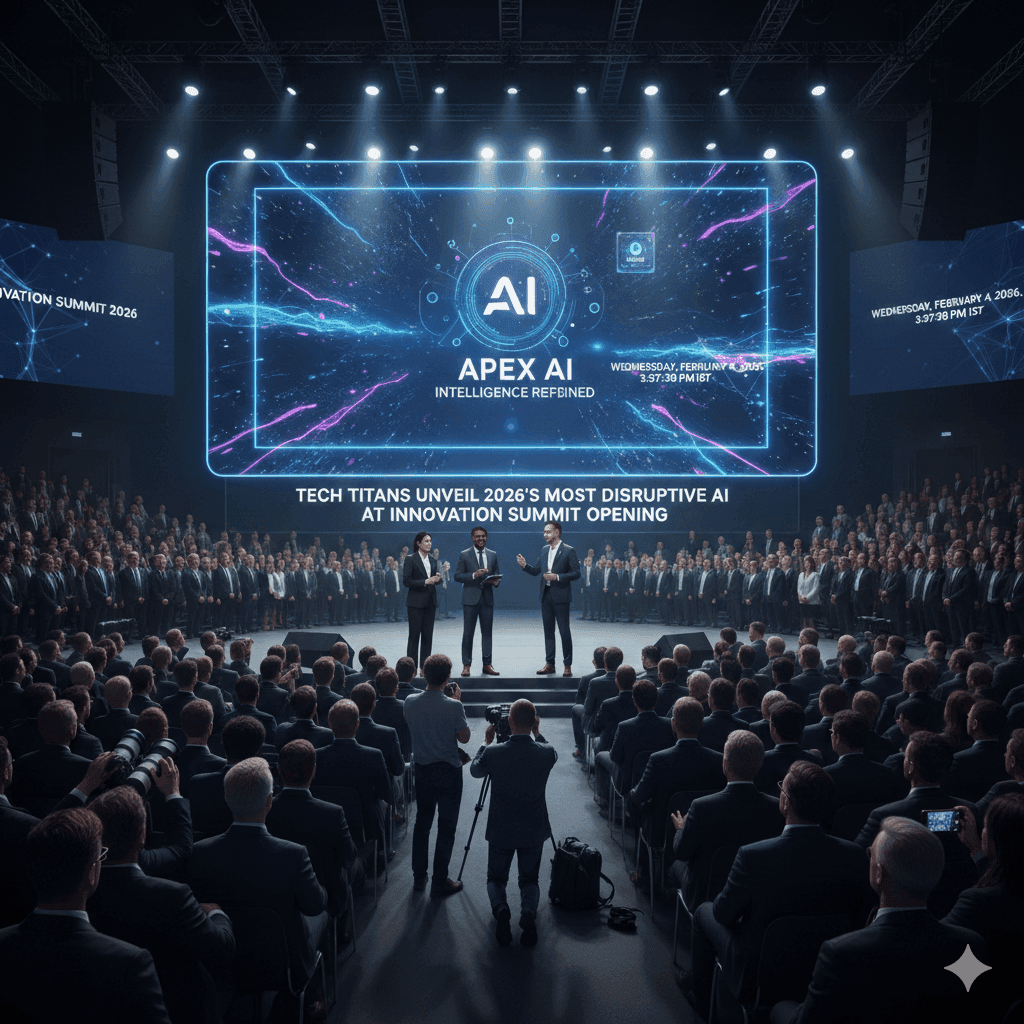
Tech Titans Unveil 2026’s Most Disruptive AI at Innovation Summit Opening
yash
February 4, 2026
Top technology executives kicked off the Innovation Summit by revealing advanced AI platforms set to transform industries, drawing investor attention and sparking debate about future workforce shifts.
Global Tech Leaders Gather at 2026 Innovation Summit to Showcase AI Breakthroughs—this headline dominated the opening hours of the highly anticipated industry event today, as top executives and visionaries unveiled a wave of next-generation artificial intelligence platforms. Held in San Francisco, this year’s innovation summit is not just bigger—it's more consequential. Major names like Alphabet, OpenAI, Microsoft, and several fast-rising startups revealed tools expected to redefine how entire sectors function, from media buying and retail analytics to healthcare diagnostics. The fresh announcements echo headlines from the past 24 hours, including Google's launch of Gemini Ultra and Meta’s demonstration of its conversational “Atlas” AI, drawing the gaze of marketers, tech investors, and workforce experts worldwide. With industry events today sparking both optimism and debate, the event’s momentum raises essential questions for anyone navigating the fast-moving digital landscape.
Why It Matters
The Innovation Summit 2026 is more than an opportunity for product showcases—it's a signal of seismic shifts across business, employment, and technology. As global tech leaders meeting at this AI technology conference unveiled new models capable of composing content, performing complex analysis, and even facilitating strategic decision-making, two challenges came to the forefront. First, the speed at which these tools are evolving—highlighted by OpenAI’s surprise overnight release of DALL-E 3 for business use—promises to supercharge marketing campaigns and customer engagement strategies. Second, the sheer scale of automation has marketers, strategists, and enterprise leaders reconsidering skills, hiring policies, and data governance.
Fresh reactions from attendees and virtual participants reflect concerns about job displacement and the urgent need for AI literacy. Yet, for many, the summit's updates—like Google's deployment of Gemini Ultra across its ad networks within hours of release—are proof that adaptability and innovation remain the name of the game. These developments explain why today’s summit carries particular weight for businesses and professionals on the front lines of technology adoption.
Innovation Summit 2026: A Showcase of AI Disruption
At the heart of the innovation summit 2026, AI platforms such as Gemini Ultra and Atlas were presented not only as tech marvels but as catalysts for industry transformation. Demonstration stages buzzed as global tech leaders revealed real-world case studies—like Target leveraging dynamic pricing algorithms built on newly trained models, and Salesforce rolling out predictive marketing dashboards powered by the latest generative AI.
Industry events today highlighted how these platforms are moving beyond text and image generation to orchestrate intricate business processes. In a session streamed live yesterday, a panel of CMOs from major retail brands discussed strategies for integrating advanced AI into omnichannel campaigns and real-time personalization engines. The ability to synchronize consumer insights, automate media buying, and optimize creative assets instantly was no longer hypothetical—it had arrived.
Industry Response: Excitement Meets Caution
The global tech leaders meeting saw an enthusiastic embrace of AI’s possibilities and thoughtful dialogue about risks. Marketers in attendance cited surveys from this week showing a 40% increase in enterprise plans to deploy AI-driven customer segmentation by Q2 2026, spurred mainly by partnerships announced at the summit. However, some executives highlighted potential pitfalls in algorithmic bias and data privacy, especially as platforms like Atlas AI begin to ingest broader, real-time datasets.
During yesterday evening’s roundtable, HR leaders discussed the rapid reskilling efforts already underway, and cybersecurity experts reminded attendees that new attack vectors can emerge as AI-powered systems proliferate. Still, optimism was unmistakable: investor interest surged, with venture capitalists pledging billions in fresh funding for AI-centric startups unveiled at the conference. The consensus? Strategic implementation matters as much as innovation itself.
Comparing with Previous Trends: The Pace Accelerates
Looking back just three years, AI technology conferences centered on foundation models and early automation pilots. Now, with the introduction of hyper-specialized AIs—and the past 24 hours bringing announcements like Meta’s “Atlas” expanding capabilities for multilingual content creation—the summit feels transformative.
Real-world examples abound: eCommerce leaders now use machine-generated trend analyses for instant product launches, and healthcare systems leverage predictive engines for patient care optimization, all powered by AI solutions referenced in this week’s summit. Compared to previous industry events, the acceleration is clear—the transition from theoretical promise to practical, large-scale impact is unfolding at breakneck speed.
Opportunities and Concerns: Navigating the AI Wave
As marketers adjust to this new reality, the summit provided key takeaways relevant to both opportunity and risk management. Companies deploying the latest AI platforms are better positioned to anticipate trends and adapt creatively, while those lagging risk operational inefficiency and diminished competitive edge. Recent updates—such as Google’s rapid integration of Gemini Ultra within its advertising ecosystem—underscore a growing imperative for businesses to stay current and AI-savvy.
Yet, concerns persist around ethical use, transparency, and potential workforce disruption. Many sessions yesterday and early today centered on best practices for responsible AI deployment, data stewardship, and inclusive training programs. The industry consensus? Vigilance, education, and cross-sector collaboration are fundamental as innovation surges forward.
Practical Implications: What This Means for Marketers and Professionals
- Early adoption of these next-gen AI tools will likely drive campaign performance and analytics sophistication for marketers.
- Reskilling, ongoing learning, and proactive policy development around AI ethics are becoming critical for all digital professionals.
For marketers and digital teams, conference insights suggest that agility and experimentation will matter more than ever. Businesses should prepare for swift changes in workflow automation, audience targeting, and creative output as these systems launch more widely in the coming months.
Market and Industry Outlook: Where Are We Headed Next?
The direction set at the Innovation Summit 2026 signals aggressive growth in AI investment, global partnerships, and cross-industry experimentation. Experts believe that, by mid-2027, AI-driven platforms will become foundational for customer interaction, productivity, and even product development cycles. Risks remain—chief among them, regulatory clarity and ethical frameworks—but the business push toward scalable, responsible AI appears unstoppable.
Recent acceleration in deployment, seen clearly in the past day’s rollouts and investor moves, hints at a market that rewards fast, quality adaptation. Marketers and tech executives should expect a wave of new entrants, as well as continual iteration of standards and practices.
Conclusion & Reader Takeaway
In summary, the 2026 Innovation Summit’s opening hours set the stage for a year defined by disruptive AI—one poised to transform marketing, customer interactions, and business intelligence. With global tech leaders gathering to showcase rapid breakthroughs, the message is clear: staying informed, skilled, and ethical is now essential for marketers seeking not just to keep pace but to set the direction. As industry events today continue to unfold, professionals are encouraged to track ongoing updates and engage thoughtfully with the opportunities and challenges that these technological advances present.